CJ posted an interesting perspective on Daylight Saving Time - DST (which in Britain we call British Summer Time - BST)
here. That and the comments that had been published when I read the post together with the spooky fact that my central heating time clock re-set itself automatically (it was presumably taking its cue from the German radio-controlled clock that I have in the kitchen, made me think. And, as my friends know, that is some achievement.
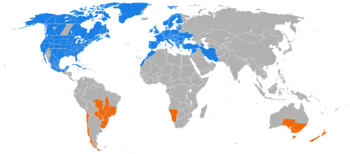
Why do we still persist with DST? Who is 'we'? I found the answer to the latter question (shown in the map) quite interesting. I hadn't realised (until I read Meike's (Librarian) comment on CJ's post that Russia with it's 9 time zones didn't observe DST. China doesn't either but I've never quite understood how China works things out given that it only has one official time even though it covers a massive five geographic time zones.
Why was DST introduced in Europe? According to Wiki Summer Time was first introduced in some countries during the
First World War, then largely abandoned with some exceptions, mostly during the Second World War, until the 1960s and 70s when the
energy crisis prompted a wide scale re-introduction. The practice has been fully coordinated across the continent since 1996.
In the UK the arguments seem to revolve around children going to school and road safety. That's purely a perception on my part by the way I've done no research on the subject. In many ways though the energy crisis would still be a relevant factor if it was relevant back in the 70s.
Here on Lewis BST makes relatively little difference because at midsummer we have sunrise around 0300 GMT and sunset around 2130 GMT but it's light(ish) all night anyway.
Anyway then I started thinking about New Zealand where I have heard a lot of discussion over recent years and where there are some wonderfully odd things as a result.
New Zealand time, including DST, is used by several Antarctic bases that are supplied from New Zealand. This results in the oddity that the Amundsen-Scott South Pole Station sets its clocks an hour further ahead during the southern summer, when the sun is constantly above the horizon, than in the southern winter, when the sun is constantly below the horizon. The extreme geographic position of the base means that no possible adjustment of the daily activity cycle can have any effect on the amount of sunlight received during those activities. However, the arrangement presumably makes real time communications with New Zealand more practical, particularly in dealing with offices.
The New Zealand dependencies of Cook Islands, Tokelau and Niue do not maintain DST. They are located on the other side of the
International Date Line and differ between 22 and 24 hours from New Zealand proper.

 Here but started There. So instead of being 11 hours ahead of Scotland, New Zealand is now 13 hours ahead. This morning should have been much lighter but I was rather upset to realise that it was still dark enough to had to put the lights on when I got up.